

TL;DR #
If you’re evaluating botanical actives for an anti-aging moisturizer and you’re still selecting ingredients based on single-compound DPPH scores, you’re leaving formulation performance on the table. The more defensible approach — and the one that holds up in finished-product testing — is optimizing a synergistic blend ratio first, then building your emulsion system around it. That’s the sequence that matters.
This article walks through the technical development of a TCM-derived anti-aging cream built on three plant-sourced actives: quercetin, kaempferol, and β-sitosterol. The formulation work here is relevant to any buyer sourcing a botanical anti-aging serum, facial cream, or face mask platform where antioxidant efficacy and emulsion stability both need to be demonstrated before commercial scale-up.
Quercetin, Kaempferol, and β-Sitosterol: Active Blend Optimization for Anti-Aging Cream Systems #
The three actives in this system are all well-characterized in botanical cosmetic applications, but their individual profiles tell only part of the story.
Quercetin is a flavonoid extractable from a broad range of fruit and vegetable sources. At 98% purity it brings strong antioxidant, anti-inflammatory, and antimicrobial activity. Kaempferol contributes anti-inflammatory and antioxidant bioactivity, with documented protective effects in oxidative stress models. β-Sitosterol is a phytosterol — present in botanicals like Angelica dahurica (白芷) and Ginkgo biloba (白果) — with recognized skin-barrier and antioxidant roles.
The critical question isn’t whether these work individually. It’s what ratio produces the highest synergistic antioxidant output in the finished matrix.
Blend Ratio Screening via DPPH Assay #
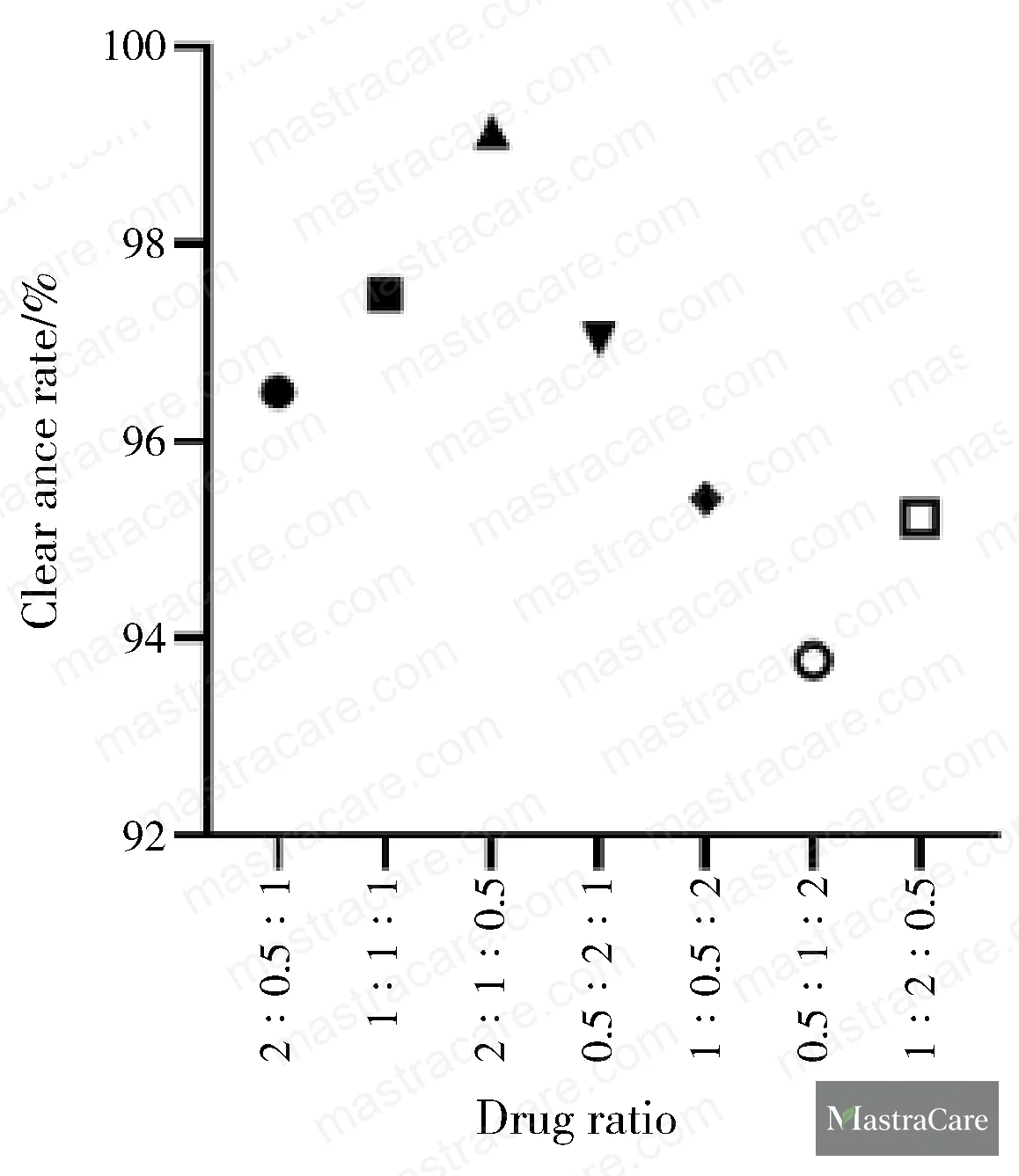
Seven blend ratios were tested (quercetin : kaempferol : β-sitosterol) at a total concentration of 60 mg/L using the DPPH (2,2-diphenyl-1-picrylhydrazyl) radical scavenging method, measured at 517 nm absorbance on a microplate reader. Each condition was run in quadruplicate.
The calculation used:
Radical scavenging rate (%) = [A₀ − (Ai − Aj)] / A₀ × 100%
Where Ai = sample + DPPH, Aj = sample + methanol, A₀ = DPPH + methanol. Reaction time: 60 min at room temperature, light-excluded.
Result: The ratio 2 : 1 : 0.5 (quercetin : kaempferol : β-sitosterol) produced the highest DPPH scavenging rate at 99.14% across all seven combinations tested. This translates to final active loading in the cream of quercetin 2%, kaempferol 1%, β-sitosterol 0.5% — totaling 3.5% botanical active complex.
Comparison of Key Active Ingredient Profiles #
| Active Ingredient | Primary Function | Recommended Loading (%) | Solubility Consideration |
|---|---|---|---|
| Quercetin (98%) | Antioxidant, anti-inflammatory, antimicrobial | 2.0 | Low water solubility — requires oil-phase or solubilizer |
| Kaempferol (98%) | Antioxidant, anti-inflammatory | 1.0 | Poor aqueous solubility — incorporate with oil phase or ethanolic pre-dispersion |
| β-Sitosterol | Phytosterol, barrier-support, antioxidant | 0.5 | Oil-phase only; heat-assisted dispersion at 65–80°C required |
Honestly, most buyers over-specify quercetin loading thinking higher means better antioxidant output. The blend ratio data here demonstrates that 2% quercetin in a 2:1:0.5 system already achieves near-ceiling scavenging activity (99.14%). Pushing quercetin above 2% in isolation does not replicate that, and it adds solubility headaches you don’t need in an emulsion base.
Emulsion Matrix Optimization: Response Surface Methodology Applied to Squalane, Emulsifier, and Water-Phase Ratio #
Getting the active blend right is step one. The harder engineering problem is building an emulsion that keeps those actives stable, delivers acceptable skin feel across a range of use conditions, and passes thermal cycling without phase separation. This is where a lot of development batches fall apart.
Single-Factor Screening Results #
The base formula was structured as an oil-in-water (O/W) emulsion with an oil phase (squalane, caprylic/capric triglyceride, beeswax) and water phase (water, glycerin, 1,3-butanediol, sodium hyaluronate 1% solution at 2%, β-glucan 1% solution at 1%, xanthan gum 1% solution at 1%). Emulsifiers used were Span 80 (primary) and cetearyl glucoside M68 (co-emulsifier) at a fixed 6:1 ratio.
Three variables were screened independently before response surface work:
- Squalane: 2.2%, 6.6%, 8.8% — acceptable range identified as 2.2–6.6%
- Emulsifier total (Span 80 + M68 at 6:1): 4.2%, 8.4%, 12.6% — acceptable range 8.4–12.6%; higher loadings increased tackiness significantly
- Oil:water ratio: tested at 1.2:3.8, 1.7:3.3, and 2:3 — optimal range 1.2:3.8 to 1.7:3.3
- Emulsification temperature: 70°C, 75°C, 80°C — optimum at 75°C
- Emulsification time: 15 min, 20 min, 25 min — optimum at 20 min
In the emulsifier screening, three of the test conditions at higher emulsifier loading produced measurably tacky, drag-heavy skin feel on panel evaluation — a straightforward example of how over-emulsifying degrades sensory performance even when emulsion stability looks fine on centrifuge. This is a friction point we see repeatedly during formulation qualification: suppliers justify a 13–15% emulsifier system on stability grounds alone, ignoring the skin feel penalty entirely.
Box-Behnken Response Surface Design #
Based on single-factor results, three variables (A: squalane %, B: emulsifier %, C: water-phase %) were taken into a Box-Behnken Design (BBD) response surface optimization using Design-Expert 13. Seventeen experimental runs with five center-point replicates were completed.
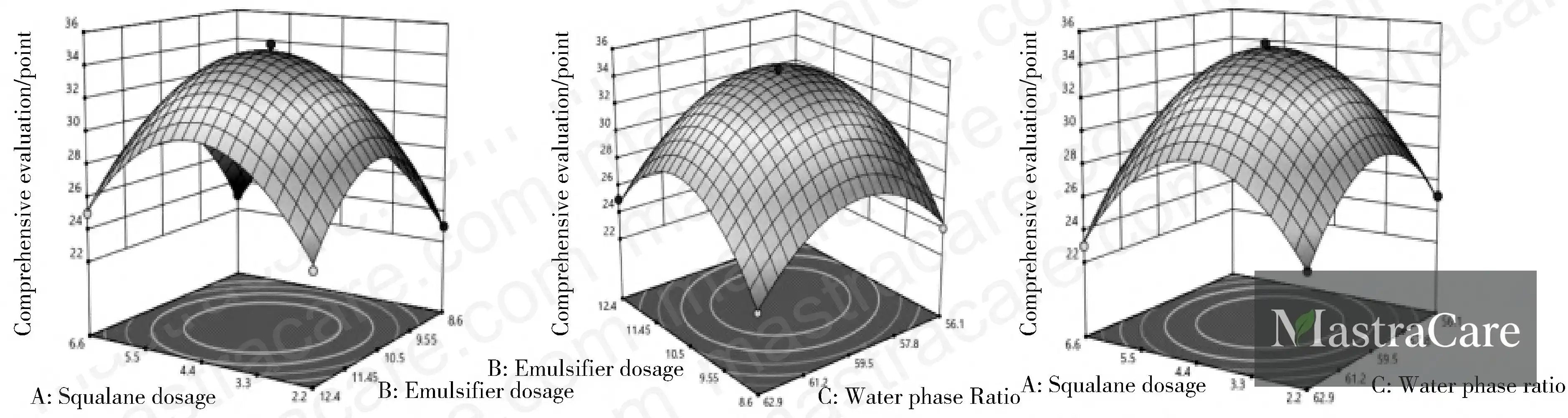
ANOVA results (R² = 0.9950):
| Factor | F-value | P-value | Significance |
|---|---|---|---|
| Model (overall) | 155.53 | < 0.0001 | Significant |
| B: Emulsifier ratio | 28.72 | 0.0011 | Significant |
| C: Water-phase ratio | 21.99 | 0.0022 | Significant |
| A: Squalane amount | 0.45 | 0.5244 | Not significant |
| Lack of fit | 0.83 | 0.5413 | Not significant |
The lack-of-fit F-value of 0.8333 with P > 0.05 confirms the model is well-fitted. The predictive equation (R² = 0.9950) showed excellent correlation between predicted and observed sensory scores.
Optimized formula outputs:
- Squalane: 4.4%
- Emulsifier (Span 80 + M68): 10.5%
- Water-phase ratio: 59.5%
What the ANOVA makes clear is that emulsifier ratio (Factor B) is the dominant variable driving finished-cream quality — more influential than either squalane level or water-phase proportion. Procurement teams sourcing emulsifier systems for this type of formula should treat emulsifier specification as the primary quality lever, not secondary.
Finished Product Quality Evaluation: pH, Stability, and Antioxidant Activity #
pH Verification #
Per the requirements of China’s Cosmetic Technology Specification (化妆品技术规范), facial creams must fall within a pH range of 4.0–8.0. The optimized formulation was tested at 40°C using a 9:1 dilution (purified water:cream) and measured with a calibrated pH meter. Result: pH 5.60 — fully compliant and within the mildly acidic range that supports skin barrier function.
Stability Testing #
Stability assessment covered four conditions aligned with ISO 29621 and standard cosmetic stability practice:
- Heat resistance (耐热)
- Cold resistance (耐寒)
- Centrifuge stability
- Ambient storage stability
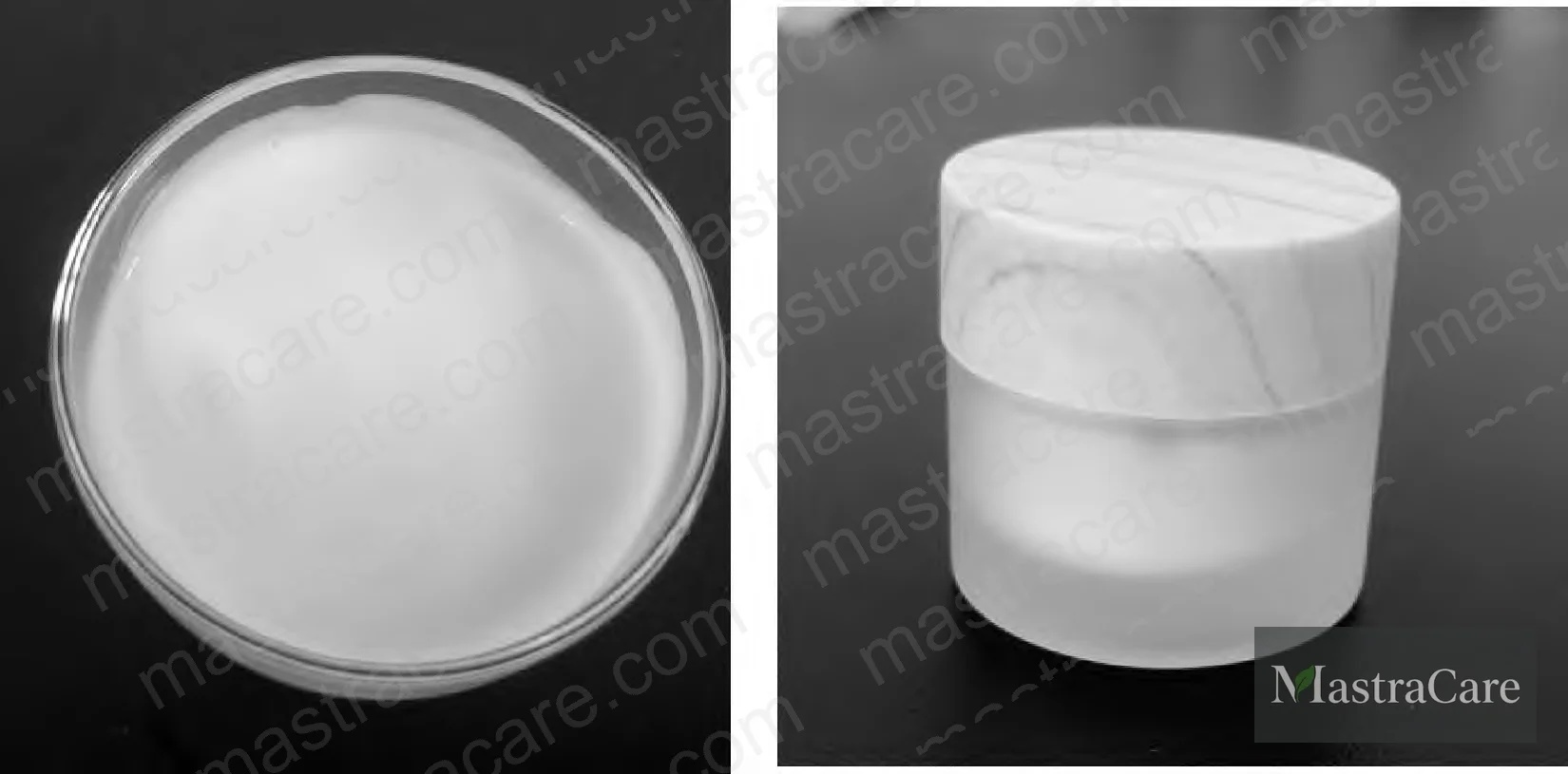
All four tests returned no phase separation, no color change, and no textural degradation. The finished cream presented as a uniform milky-white paste with no visible particulates and no irritating odor.
Antioxidant Activity in Finished Cream #
The critical validation step: after all processing — emulsification at 75°C, post-emulsification cooling, hot-phase and cool-phase addition of actives — does the antioxidant complex retain its activity?
The finished cream was diluted 10-fold in purified water, vortex-mixed, and evaluated by DPPH at 517 nm using the same 96-well protocol as the blend screening. Radical scavenging rate of the finished cream: 84.75%.
Starting from 99.14% at the raw blend stage, the formulated cream retains 84.75% scavenging activity — an approximately 14-point drop attributable to dilution effect and matrix interactions during emulsification. That’s a defensible retention figure, and it’s worth noting that quercetin and kaempferol were added at the cool-down stage (below 45°C) specifically to protect heat-sensitive flavonoid structures. β-Sitosterol, being more thermally stable, was incorporated with the oil phase at 65–80°C.
Most procurement teams don’t realize that the addition sequence for botanical actives in emulsion systems is frequently under-specified in supplier COA documentation. The difference between adding a flavonoid at 80°C versus 45°C can represent a 15–30% activity loss — yet batch records rarely capture this detail at the ingredient supplier level. This is an area where asking for process-specific stability data, not just raw material DPPH values, changes the conversation significantly.
Practical Guidance for Buyers #
If you’re sourcing a botanical anti-aging cream system with a verified antioxidant mechanism, the blend ratio data here gives you a concrete specification anchor: quercetin 2% / kaempferol 1% / β-sitosterol 0.5% is the validated high-performance ratio, not a starting approximation. Ask suppliers for DPPH data on the specific blend — not individual actives in isolation — and require measurement conditions (concentration, reaction time, wavelength) to be documented.
For the emulsion base, squalane at 4.4% and total emulsifier at 10.5% are workable commercial targets, but the real specification gate is the water-phase proportion at 59.5%. Response surface data confirms that small deviations in water-phase loading produce larger sensory score variance than equivalent deviations in oil phase — something most emulsion spec sheets don’t reflect.
Stability documentation should cover all four conditions (heat, cold, centrifuge, ambient) with explicit pass/fail criteria. pH compliance to the 4.0–8.0 range is mandatory under Chinese cosmetic technical standards and maps closely to EU Cosmetics Regulation (EC) No 1223/2009 requirements for skin-contact pH safety.
At MastraCare, our formulation team in Guangzhou regularly develops botanical active systems of this type for private label and OEM clients across North America, Europe, and the Middle East — supporting everything from ingredient qualification to finished product stability packages. If you’re at the RFQ stage for a TCM-derived anti-aging moisturizer or serum, we can match actives sourcing to your target market’s regulatory framework from the start.
Frequently Asked Questions #
Why is the quercetin:kaempferol:β-sitosterol ratio 2:1:0.5 specifically, and not higher quercetin?
Seven distinct ratios were screened at identical total concentration (60 mg/L) using DPPH radical scavenging as the objective measure. The 2:1:0.5 combination produced the peak scavenging rate of 99.14% — outperforming all other ratios tested, including those with higher relative quercetin fractions. Synergistic interaction between the three actives, not quercetin alone, drives the result. Scaling quercetin independently does not replicate the blend performance and adds solubility complications in the oil phase.
What explains the drop from 99.14% DPPH scavenging in the raw blend to 84.75% in the finished cream?
Two main factors: dilution effect from the full emulsion matrix, and some activity loss during processing. The active blend represents 3.5% of total formula weight; in the finished cream the effective antioxidant concentration is lower relative to the full matrix. To protect heat-sensitive flavonoids (quercetin, kaempferol), they are added at cool-down — below 45°C — rather than in the heated oil phase. β-Sitosterol, which is thermally stable, goes in with the oil phase at 65–80°C. The 84.75% finished-cream result confirms the addition sequence is working.
Does the squalane source (plant-derived vs. synthetic) affect formulation performance here?
For this emulsion system, squalane at 4.4% functions primarily as an emollient and skin-protective film-former. Response surface analysis showed squalane level (Factor A) was the least statistically significant variable — P = 0.5244, well above the 0.05 significance threshold. Whether plant-derived or synthetic, the functional impact at this loading level is equivalent. Source selection is more relevant from a regulatory labeling or sustainability claims perspective than from a formulation performance standpoint.
What stability tests are required before this formula can be commercialized?
The study conducted four stability protocols: heat resistance, cold resistance, centrifuge separation, and ambient storage — all per China’s Cosmetic Technology Specification. All four passed with no phase separation or color change. For commercial products targeting EU or North American markets, additional testing per ISO 29621 and market-specific stability guidelines will typically be required, including photostability if UV-active botanicals are present and preservative efficacy testing.
Can this active blend be adapted into a serum or essence format rather than a cream?
Yes, but solubility management becomes the primary challenge. All three actives have limited aqueous solubility — quercetin and kaempferol especially so. In a cream, the oil phase accommodates them cleanly. In a water-continuous serum or toner system, you’d need a solubilization strategy: hydrotropes, cyclodextrins, or liposomal encapsulation. Encapsulation also has the benefit of improving active retention through the emulsification process, which would likely improve on the 84.75% finished-product scavenging rate achieved here. See our encapsulation technology documentation for system options.
Published by mastracare.com Technical Team | Request a sourcing quote
Content reviewed by nina.huang | © mastracare.com — All rights reserved. Unauthorized reproduction prohibited.


