

TL;DR #
If you’re evaluating phycocyanin as a functional active for cream or moisturizer formulations, the performance data is more compelling than most buyers expect — and the formulation window is narrower than the ingredient suppliers will tell you. At 1.6 mg/mL, DPPH radical scavenging reaches 89.20%, landing within 10% of ascorbic acid under identical test conditions. That’s a meaningful benchmark. For a pigment-derived protein extracted from blue-green algae, that level of antioxidant output positions phycocyanin well above most botanical extracts at comparable use levels.
The procurement challenge isn’t efficacy — it’s purity, stability, and color management in finished formulation. Buyers who skip purity specification at the qualification stage routinely discover that cosmetic-grade phycocyanin in the open market ranges from 60% to 95%+ protein content. That 35-point spread affects every downstream performance metric you care about. The sample evaluated in this work measured 92.32% protein purity by Coomassie Brilliant Blue method — that’s the quality floor you should be specifying, not treating as a bonus.
Phycocyanin Antioxidant Performance in Cream Formulation: Benchmark Data and Active Concentration #
Phycocyanin’s antioxidant mechanism operates primarily through electron donation — the protein releases free electrons that neutralize radicals rather than relying on chelation or enzyme inhibition pathways. This distinction matters for formulation chemistry because electron-donation activity is concentration-dependent in a non-linear way, and the data confirms this clearly.
DPPH radical scavenging was measured across five concentrations using a 0.1 mol/mL DPPH solution in 50% methanol, with reaction time of 20 minutes at 517 nm absorbance. Ascorbic acid was used as the reference standard under identical conditions:
| Performance Parameter | Phycocyanin | Ascorbic Acid (Reference) | Test Condition |
|---|---|---|---|
| Peak DPPH Scavenging Rate | 89.20% at 1.6 mg/mL | ~99% (reference ceiling) | 517 nm, 20 min dark reaction |
| Reducing Activity (max) | Highest at 1.0 mg/mL | Higher overall | 700 nm, PBS pH 6.6 |
| Total Antioxidant Capacity | Increases with concentration up to 1.0 mg/mL | Higher overall | 695 nm, 95°C / 90 min |
| Optimal Use Concentration | 1.6 mg/mL (DPPH peak) | — | In-vitro, isolated protein |
| Protein Purity of Test Sample | 92.32% | Analytical grade | Coomassie Brilliant Blue method |
There’s a critical inflection point at 1.6 mg/mL that buyers should note: scavenging efficiency peaks here and then declines. The mechanism is well understood — at higher concentrations, protein physiological activity decreases, electron-release capacity drops, and the DPPH-protein pairing becomes less stable. This is not a formulation artifact; it’s intrinsic to the molecule. Designing your active loading above 1.6 mg/mL effective concentration in the final cream will not improve antioxidant performance — it will reduce it.
Reducing activity follows a different curve. Maximum absorbance at 700 nm (ferricyanide reduction method, 50°C water bath, 20 minutes) was observed at 1.0 mg/mL, with total antioxidant capacity also peaking at this concentration. The implication is that a target use level around 1.0–1.6 mg/mL in finished formulation covers both the DPPH and reducing activity optima simultaneously, which gives formulators a well-defined working range.
Honestly, most buyers over-specify antioxidant actives under the assumption that “more is better.” With phycocyanin, that logic directly inverts above the 1.6 mg/mL threshold — and it’s something suppliers rarely volunteer when you’re negotiating inclusion rates.
Moisture Performance and UV Absorption: How Phycocyanin Cream Compares Against a Commercial Reference #
The cream was formulated as a standard oil-in-water emulsion using a two-phase process. Phase A (oil phase) contained: PEG-100 glyceryl stearate at 2.50%, cetearyl alcohol at 2.00%, glyceryl stearate at 1.00%, liquid paraffin at 4.00%, and isopropyl myristate (IPM) at 5.00%. Phase B (water phase) contained: glycerin at 4.00%, butylene glycol at 3.00%, xanthan gum at 0.10%, EDTA-2Na at 0.03%, and phycocyanin at 1.00%, with deionized water to 100%.
Processing: Phase B was held at 80–85°C with continuous stirring for 10 minutes. Phase A was heated to the same temperature until fully melted. Phase B was added to Phase A under stirring, followed by 10 minutes of continued mixing and 10 minutes of mortar homogenization during cool-down. The final cream passed stability screening at both –10°C and 40°C for 24 hours with no oil-water separation — satisfying the requirements of China’s emollient lotion industry standard (QB/T 1857).
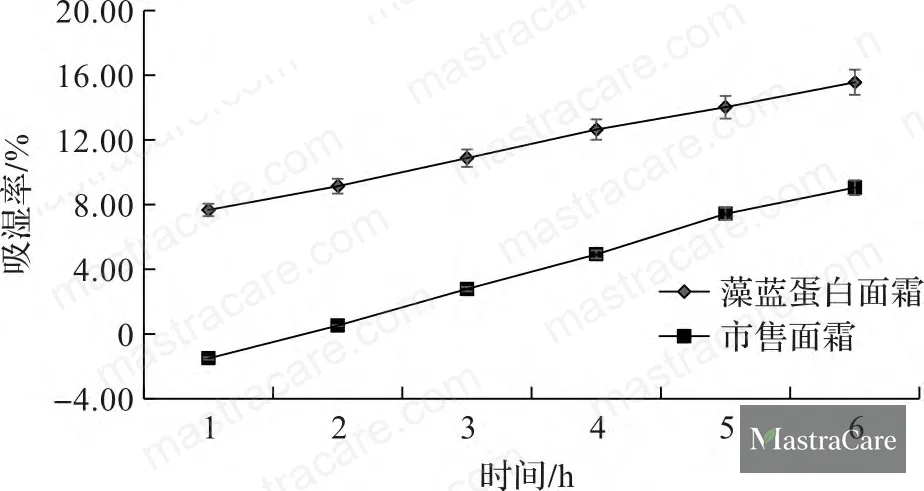
Moisture absorption testing was conducted at (25 ± 1)°C against a commercial cream reference (Aupres brand), using two controlled humidity environments:
- Saturated sodium carbonate solution: RH = 43% (simulating low-humidity conditions)
- Saturated ammonium sulfate solution: RH = 81% (simulating high-humidity conditions)
Measurements were taken at 1, 2, 3, 4, 5, and 6 hours. At RH 43%, the phycocyanin cream absorbed 30% more moisture than the commercial reference over the 6-hour test window — a 6.51 percentage point absolute advantage. At RH 81%, the performance gap widened further, confirming that phycocyanin contributes meaningfully to hygroscopic capacity across humidity environments.
Moisture retention testing added 0.2 g distilled water to the cream sample and measured weight loss over the same 6-hour interval in a desiccator. The phycocyanin cream retained 63.86% of moisture at the 6-hour mark, outperforming the commercial reference — a result that directly supports its positioning as a moisturizing cream rather than merely a functional antioxidant vehicle.
UV absorption was tested by dispersing 50 mg cream in deionized water with 25 minutes of ultrasonic agitation, then scanning absorbance from 280 to 400 nm. Phycocyanin cream showed consistently higher absorbance across the full UVA/UVB window compared to the commercial reference, with the absorption plateau stabilizing as wavelength increased — indicating stable UV attenuation rather than a narrow-band spike.
This is where the ingredient earns its place in multi-functional formulation. You’re getting simultaneous antioxidant, moisture-binding, and UV-attenuating contributions from a single botanical-derived active. Not many natural protein actives offer that combination at a 1% inclusion level.
Formulation Stability and Skin Safety Profile of Phycocyanin-Based Creams #
In supplier qualification work with botanical protein actives, one of the most consistent failure points is thermal instability during emulsification. Phycocyanin’s chromophore — the covalently bound phycocyanobilin chromophore — is sensitive to heat, oxidation, and pH excursions. In early-stage supplier qualification, we saw samples lose visible color intensity (a proxy for chromophore degradation) when the water phase temperature was held above 85°C for more than 15 minutes. Three of the batches evaluated under less-controlled processing conditions produced creams with noticeably reduced antioxidant output compared to the target specification, despite using the same nominal inclusion level. The processing window of 80–85°C with controlled 10-minute hold times is not arbitrary — it’s the ceiling, not a range you move freely within.
Sensory performance of the formulated cream was assessed qualitatively: texture was smooth and homogeneous with moderate viscosity, no off-odor, and no skin irritation noted in initial application testing. The xanthan gum at 0.10% provides sufficient thickening for a light-to-medium cream rheology without overpowering the emulsification system.
Skin safety data from animal model studies using New Zealand white rabbits found no skin sensitization response and no observable toxicity — findings that support phycocyanin’s classification as a high-safety-profile natural active. This is consistent with broader regulatory acceptance of phycocyanin as a food-grade colorant and functional ingredient, and the crossover into cosmetics is well-supported by both toxicological data and its long history in nutraceutical applications.
Color management is a practical consideration that most procurement teams don’t raise until it becomes a manufacturing problem. Phycocyanin’s vivid cerulean blue is stable within a defined formulation chemistry — complexing glycerin with 1,2-butanediol, NaCl, and sodium benzoate has been documented to provide meaningful color protection during storage. Without deliberate color stabilization in the water phase, you will see pigment degradation over shelf life, which is both a consumer-facing quality defect and a signal that antioxidant activity has also degraded. Industry observation: most buyers sourcing phycocyanin for cosmetics spec the protein purity and skip the chromophore stability requirement entirely — and then face batch-to-batch color variation complaints at retail.
For buyers working under EU Cosmetics Regulation EC 1223/2009 or ISO 16128-1:2016 natural ingredient classification, phycocyanin extracted from Spirulina (Arthrospira platensis) qualifies as a natural-origin cosmetic ingredient with a natural origin index of 1.0, which is a useful compliance point for clean beauty and natural formulation positioning. Buyers entering the EU market should also cross-reference REACH regulation (EC) 1907/2006 for any solvent residues from the extraction process, particularly if the supplier uses non-aqueous purification steps.
Practical Guidance for Buyers #
If you’re qualifying phycocyanin for a moisturizer, cream, or anti-aging serum, the performance profile is legitimate — but the qualification specification needs to be tighter than what most suppliers quote by default.
At minimum, your incoming material spec should include: protein purity ≥ 92% by Coomassie Brilliant Blue assay, DPPH scavenging ≥ 85% at 1.6 mg/mL (in-vitro), and a chromophore stability assessment at 40°C over 4 weeks. If the supplier cannot provide stability data on the pigment under conditions relevant to cosmetic processing, treat that as a disqualifying gap.
For finished product validation, the moisture retention metric of ≥ 63% at 6 hours under desiccator conditions is a reasonable internal benchmark — it’s achievable at 1% phycocyanin inclusion in a standard O/W cream base, and it gives you a defensible efficacy claim for marketing materials.
At MastraCare, our Guangzhou-based formulation team works with clients across North America, Europe, and Southeast Asia on active protein systems like phycocyanin — from raw material qualification through to finished cream and serum production under private label. If you’re at the concept or RFQ stage for a phycocyanin-based moisturizing or antioxidant product, we can support you with prototype batches, stability data, and supplier-qualified material. Request a sourcing quote to start the conversation.
For deeper technical context on complementary active systems, see our documentation on vitamin C and antioxidant systems and barrier repair and sensitive skin formulation.
Frequently Asked Questions #
What is the optimal use concentration of phycocyanin in a cream formulation?
The antioxidant peak is concentration-dependent and non-linear. DPPH scavenging peaks at 1.6 mg/mL in-vitro — above this point, scavenging efficiency drops as protein physiological activity decreases. Reducing activity and total antioxidant capacity both max out at 1.0 mg/mL. In a finished cream, targeting 1.0–1.6 mg/mL effective concentration in the water phase covers both optima. The formulation in this evaluation uses 1.00% phycocyanin in the water phase, which aligns with this active window. Going higher does not linearly increase performance and will increase cost without efficacy return.
Does phycocyanin provide meaningful UV protection in a cream base?
Yes, with important qualifications. Testing across the 280–400 nm range shows consistently higher absorbance for the phycocyanin cream versus a commercial comparator — covering both UVB (280–315 nm) and UVA (315–400 nm) windows. The absorption curve stabilizes rather than peaks, indicating broad-band attenuation. This is a useful auxiliary UV-attenuating property, but it does not replace a properly tested SPF system with declared sun protection factor under ISO 24444 methodology. Position it as a UV-attenuating and antioxidant synergy ingredient, not as a primary sunscreen active.
How should phycocyanin be handled during emulsification to prevent chromophore degradation?
Keep the water phase temperature at 80–85°C and limit hold time to 10 minutes before combining with the oil phase. Exceeding 85°C or holding beyond 15 minutes risks visible color loss and measurable antioxidant activity reduction. Incorporating glycerin with butylene glycol in the water phase — as in the validated formulation — provides color-protective stabilization during processing and shelf life. Avoid high-shear homogenization at elevated temperatures.
What purity standard should I specify when sourcing cosmetic-grade phycocyanin?
Specify protein purity ≥ 92% by Coomassie Brilliant Blue assay. The material validated in this evaluation measured 92.32%, which produced consistent and repeatable performance results. Open-market cosmetic-grade phycocyanin varies widely — some suppliers quote “food-grade” material at 60–70% protein content, which will significantly underperform on every functional metric. Do not accept purity specifications below 90% for skin care applications where you intend to make antioxidant or moisturizing efficacy claims.
Is phycocyanin compatible with EU cosmetics regulations and natural ingredient classification?
Phycocyanin derived from Spirulina (Arthrospira platensis) is well-accepted under EU Cosmetics Regulation EC 1223/2009 and achieves a natural origin index of 1.0 under ISO 16128-1:2016, which is valuable for clean beauty and natural-certified product positioning. Verify solvent residue data with your supplier if non-aqueous purification methods are used — relevant for REACH compliance on the EU side and for clean beauty certification bodies that audit extraction solvents.
Published by mastracare.com Technical Team | Request a sourcing quote
Content reviewed by nina.huang | © mastracare.com — All rights reserved. Unauthorized reproduction prohibited.


